I recently had a talk with a swedish friend about the danger of media and then more than ever, I understood how in Italy things have gone far, too far. First of all I need to go deeper into the very definition of media. The Latin medium is to be translated "mean", something with which you achieve a purpose, a goal. The communication mass media is the mean with which the people constantly get information.

After the fall of the Roman Empire (476 a.c.) the cities got empty because the people moved to the country founding new villages; At this point the roman catholic church became the biggest mass media in European history. Their power was absolute and lasted for more than 1000 years. They had the power to inform people about anything they wanted, and there was no alternative, no opposition to their news. They were the holders of the truth not because they actually had the truth, but because nobody else had power to say something different.

The big change happened during contemporary history, the first encyclopedia and the first news papers; before the invention of the printers most of the books were hand written by monks but now they were losing their monopoly over information, and for a while the press has been free from the power; the invention of TV put in danger this freedom.
On TV the information is immediate, always up to date minute after minute. On TV information became formation and education. Children grow up in front of the TV, adults get almost 100% of their perception of the world watching TV. People choose who to vote watching TV.

Of course internet is a good alternative to TV, but some elements make it ineffective in Italy; on the internet you get what you look for, so you get free information only if you look for it, otherwise you get just a photocopy of what you have already seen on TV. Second, is very rare that adults over 40 know how to use a computer, and international media are basically inaccessible to most Italians because really few people understand English. In such a country if you have access to press and TV you have access to the same power once owned by the Roman Church; the Absolute power.
 |
| Silvio Berlusconi with Bettino Craxi |
Being aware of this danger, in Italy it was forbidden by law to own a national broadcasting TV channel, so the only three were those of the state owned company Rai, the equivalent to Svt. I will not go too deep about which powers moved a man to take over Italians media, I will only write about how he did it. During the 80s a man from Milan named Silvio Berlusconi bought off several local TV channels, almost one for each italian region. Later he started broadcasting the same programs in all regions, at the same time, with the same commercials. Of course this violated the law about television monopoly, so Berlusconi was called on a trial, this trial never happened though.
During the late 80s the government (Craxi) pushed the parliament to remove the monopoly on television. The left wing opposition didn't fight against it because they got to control one of the Rai channel. This is how Berlusconi got to keep his three national channels (Mediaset). This is what I call the pact with the devil, and this is why the left wing parties in Italy need to be completely reformed, they are still the same people who sold Italy to Silvio Berlusconi.
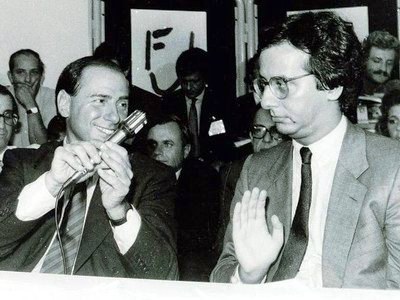 |
| Berlusconi and the former Democratic Party leader |
Owning three national TV channels, and a very big part of the press (Mondadori Group), he founded a party and ran for parliament election after a few years; He won and became prime minister in the early 90s, and by doing this he took power of the state owned TV channels. Nowadays he controls 6 over 8 national channels (the other 2 are Mtv and a minor channel), his power is Absolute.
If there is only one voice telling a story, people will believe it to be true. If the same story is told for 15 years, people will believe it to be the only Truth.
Television is now the italian state religion, with the worst creed ever: consumerism is the path to happiness.
A.U.
Published in Stockholm on Huvudstadsbladet (october 2010)

Nessun commento:
Posta un commento